May Safety Moment - The Safety Evolution in Canada
Safety didn't always look the way it does today.
Canadian workplaces used to be dangerous, unhygienic, and unforgiving. If a worker got hurt, the logic was simple. You knew the job was dangerous when you took it. You accepted the risk.
Early safety law was built around this idea. It was called assumption of risk. If you were injured, it was considered part of the job. Even in industries like mining, forestry, and rail, the responsibility landed almost entirely on the worker. At the same time, early psychologists and researchers believed incidents happened because some people were just “accident prone.” If you got hurt, the problem wasn’t the work, the equipment, or the conditions. The problem was you.
That thinking protected companies. It did nothing to protect workers.
What changed wasn’t compassion. It was pressure. As industry expanded, injuries and deaths became impossible to ignore. Workers organized. Unions formed. Advocates pushed for accountability. Governments started collecting data instead of accepting excuses.
Researchers like H.W. Heinrich were tasked with analyzing large volumes of workplace incident data for insurance companies. What he found challenged the idea that incidents were random or unavoidable.
Heinrich proposed what became known as the accident triangle. The idea was that for every major injury, there were many minor injuries and hundreds of near misses underneath it. The takeaway was simple and powerful for its time. If you reduce minor incidents and near misses, you reduce serious injuries.
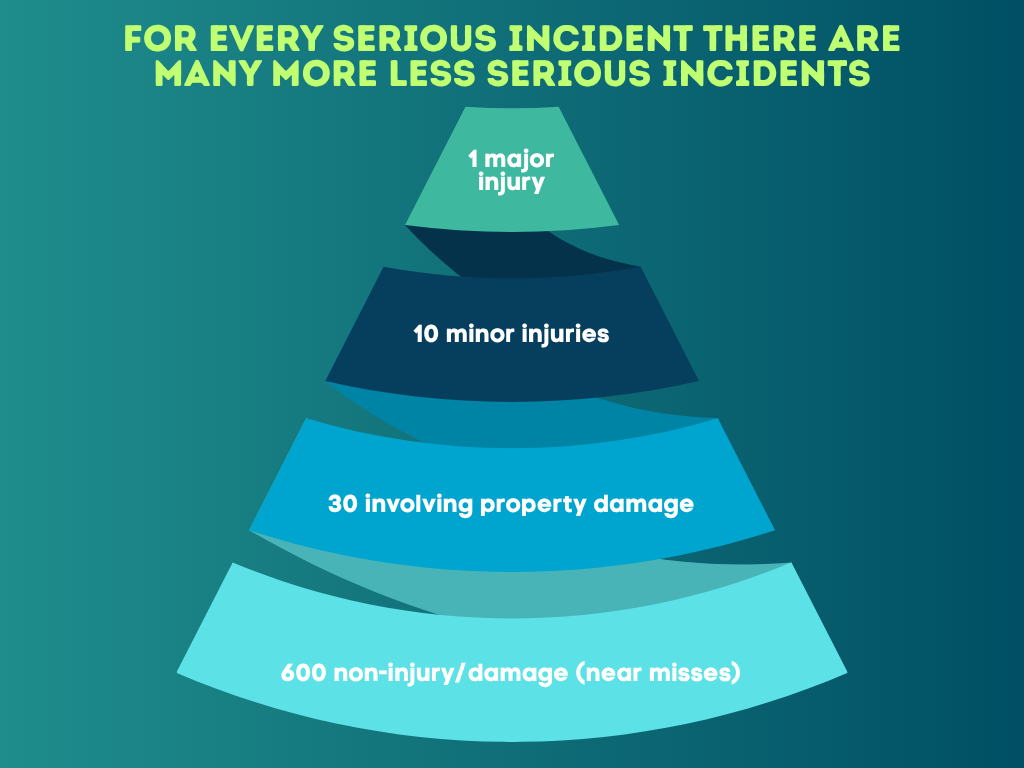
That thinking mattered. It shifted safety away from blame and toward prevention. But here’s the part that often gets missed.
The triangle is not a law of nature. It’s not predictive. And it’s not reliable when applied blindly today. Serious injuries don’t always follow a neat progression. You can go months or years with no minor incidents and still have a fatality. Focusing only on counting small incidents can create a false sense of security and distract from high-risk work that hasn’t gone wrong yet.
What did hold up from Heinrich’s work was the bigger idea. Incidents have multiple contributing causes, and systems matter more than individual mistakes. That insight forced a shift. If incidents were predictable, they were preventable. If they were preventable, someone had to be responsible for prevention. That responsibility moved to employers.
Modern safety legislation is built on that shift. Not because employers are villains, but because they control the systems. The equipment. The training. The supervision. The pace of work. Modern safety exists because people got hurt, spoke up, organized, and proved that the old way didn’t work.
Safety stopped being about who messed up. And started being about what failed.
That shift is the foundation of every safety program, every audit, and every regulation we work with today. Not to react after someone gets hurt. But to design work so fewer people get hurt in the first place.


